Bankable partnerships anchor renewables momentum

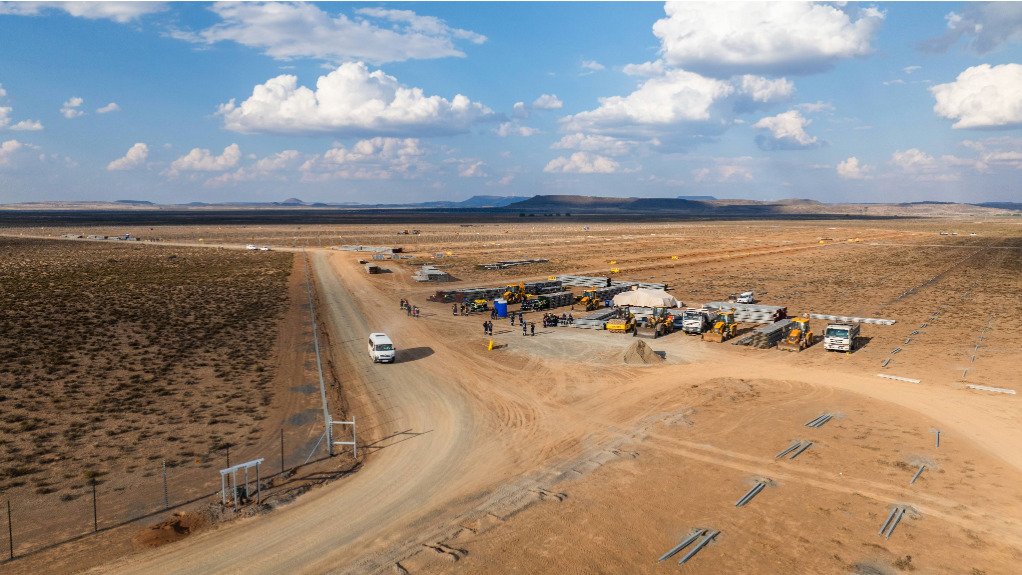
MILESTONE SHIFT Mulilo’s Du Plessis Dam Solar PV 2 marks a turning point in South Africa’s renewables landscape, signalling the growing maturity and bankability of large-scale private offtake projects


With the renewables sector moving beyond proof-of-concept into industrial-scale deployment, South Africa’s leading financiers are playing a pivotal role in translating policy ambition into bankable infrastructure. For Standard Bank Corporate and Investment Banking (CIB), success in scaling up renewable-energy projects hinges on collaboration, disciplined risk allocation and a growing ecosystem of private offtake models reshaping the country’s energy market.
South Africa’s renewable-energy landscape continues to evolve as projects under public procurement and private contracting frameworks advance to financial close, says Standard Bank CIB power head Rentia van Tonder. Standard Bank has emerged as one of the leading financiers enabling this shift, combining traditional project-finance rigour with innovative structures tailored to a more liberalised energy environment.
A recent example of this is the Du Plessis Dam Solar PV 2 facility — a 75 MW AC (105 MW DC) solar PV project, developed by renewable-energy companies Mulilo Renewable Energy and Etana Energy, near De Aar, in the Northern Cape. Supported by Standard Bank’s project finance division, the project reached financial close earlier this year, marking one of South Africa’s first large-scale privately wheeled solar transactions selling to a trader.
Van Tonder notes that the transaction underscores the market’s growing appetite for private offtake projects – developments that supply electricity directly to industrial and commercial clients outside of the traditional State-owned power utility Eskom framework and in this case through an energy trader.
“The deal showcases how effective partnerships and disciplined risk allocation can unlock scale in renewables. It also underlines the maturing confidence in South Africa’s renewables ecosystem from developers to financiers, regulators and corporates,” she says.
Driving New Generation
While government-led procurement under the Renewable Energy Independent Power Producer Procurement Programme remains foundational, a parallel market has emerged, where corporate and industrial buyers procure power directly through power purchase agreements (PPAs) with independent power producers (IPPs). Etana Energy’s role as a trader in the Mulilo project highlights this trend - marking one of the first large-scale private wheeling arrangements to secure bank funding.
Van Tonder says this model aligns with Standard Bank’s strategic approach to diversify the country’s energy supply chain while supporting private-sector resilience.
“Private offtake models are crucial to bridging South Africa’s supply gap and ensuring energy resilience. They give corporate buyers flexibility while introducing more liquidity and competition into the market.”
The model relies on replicable, standardised PPAs that make projects bankable even in the absence of State-backed guarantees. It also enables developers to aggregate multiple buyers through a portfolio approach, spreading risk and accelerating execution. She adds that such structures reflect international best practice, mirroring developments in Latin America and Asia, where decentralised generation has unlocked rapid renewables investment.
Project Specifics
Mulilo’s Du Plessis Dam Solar PV 2 plant illustrates the scale and complexity of this new generation of renewables projects. Located about 5 km outside De Aar – one of the country’s highest irradiance regions, the facility will deploy around 170 000 bifacial solar modules mounted on single-axis trackers and integrated through ten modular inverter-transformer stations. Once operational, it will generate roughly 249 GWh/y of electricity, equal to powering 86 000 households.
“The exceptional solar resource, coupled with strong grid access and local support, made this site ideal for development. Beyond its technical ambition, the project demonstrates how early stakeholder engagement, detailed logistics planning and community partnerships are critical to maintaining stability and momentum through construction,” highlights Mulilo Renewable Energy CEO Jan Fourie.
He adds that, as with most large-scale projects in the Northern Cape, transporting large components and facilitating a sustained local interface were significant considerations and these challenges were mitigated through detailed route surveys, phased delivery schedules and the appointment of a dedicated community liaison officer to ensure transparent engagement and the establishment of formal grievance mechanisms.
Standard Bank acted as lead arranger and sole financier at financial close, structuring the transaction on terms that reflect its commitment to inclusive renewable-energy ventures.
“The project aligns strongly with Standard Bank’s mandate to finance black-owned and inclusive renewables ventures,” Van Tonder says, adding that, by working with developers such as Mulilo, Etana and H1 Holdings, the bank is ensuring that the energy transition is both “economically and socially sustainable”.
“Once operational, the facility will deliver zero-emission electricity, create more than 600 direct jobs during construction and contribute to long-term local economic resilience. It stands as proof that South Africa’s private renewables sector can deliver scale, inclusion and technical excellence in one integrated model,” Fourie adds.
As South Africa works to stabilise its electricity supply and deliver on its net-zero commitments, the renewable-energy narrative is shifting from individual projects to long-term systems building, Van Tonder highlights. For financiers, the challenge and opportunity lie in transforming sound partnerships into lasting energy infrastructure that strengthens economic growth.
Article Enquiry
Email Article
Save Article
Feedback
To advertise email advertising@creamermedia.co.za or click here


Projects

Latest Multimedia
Latest News

Showroom

ATI systems comprises five divisions: electrical assemblies, drives and controls, feedback sensors, enclosures, and strip guiding.
VISIT SHOWROOM
Sulzer South Africa, established in 1922, partners with critical industries like power, oil & gas, water, mining, and chemicals to boost...
VISIT SHOWROOM



Press Office
Announcements
What's On
Subscribe to improve your user experience...
Option 1 (equivalent of R125 a month):
Receive a weekly copy of Creamer Media's Engineering News & Mining Weekly magazine
(print copy for those in South Africa and e-magazine for those outside of South Africa)
Receive daily email newsletters
Access to full search results
Access archive of magazine back copies
Access to Projects in Progress
Access to ONE Research Report of your choice in PDF format
Option 2 (equivalent of R375 a month):
All benefits from Option 1
PLUS
Access to Creamer Media's Research Channel Africa for ALL Research Reports, in PDF format, on various industrial and mining sectors
including Electricity; Water; Energy Transition; Hydrogen; Roads, Rail and Ports; Coal; Gold; Platinum; Battery Metals; etc.
Already a subscriber?
Forgotten your password?
Receive weekly copy of Creamer Media's Engineering News & Mining Weekly magazine (print copy for those in South Africa and e-magazine for those outside of South Africa)
➕
Recieve daily email newsletters
➕
Access to full search results
➕
Access archive of magazine back copies
➕
Access to Projects in Progress
➕
Access to ONE Research Report of your choice in PDF format
RESEARCH CHANNEL AFRICA
R4500 (equivalent of R375 a month)
SUBSCRIBEAll benefits from Option 1
➕
Access to Creamer Media's Research Channel Africa for ALL Research Reports on various industrial and mining sectors, in PDF format, including on:
Electricity
➕
Water
➕
Energy Transition
➕
Hydrogen
➕
Roads, Rail and Ports
➕
Coal
➕
Gold
➕
Platinum
➕
Battery Metals
➕
etc.
Receive all benefits from Option 1 or Option 2 delivered to numerous people at your company
➕
Multiple User names and Passwords for simultaneous log-ins
➕
Intranet integration access to all in your organisation